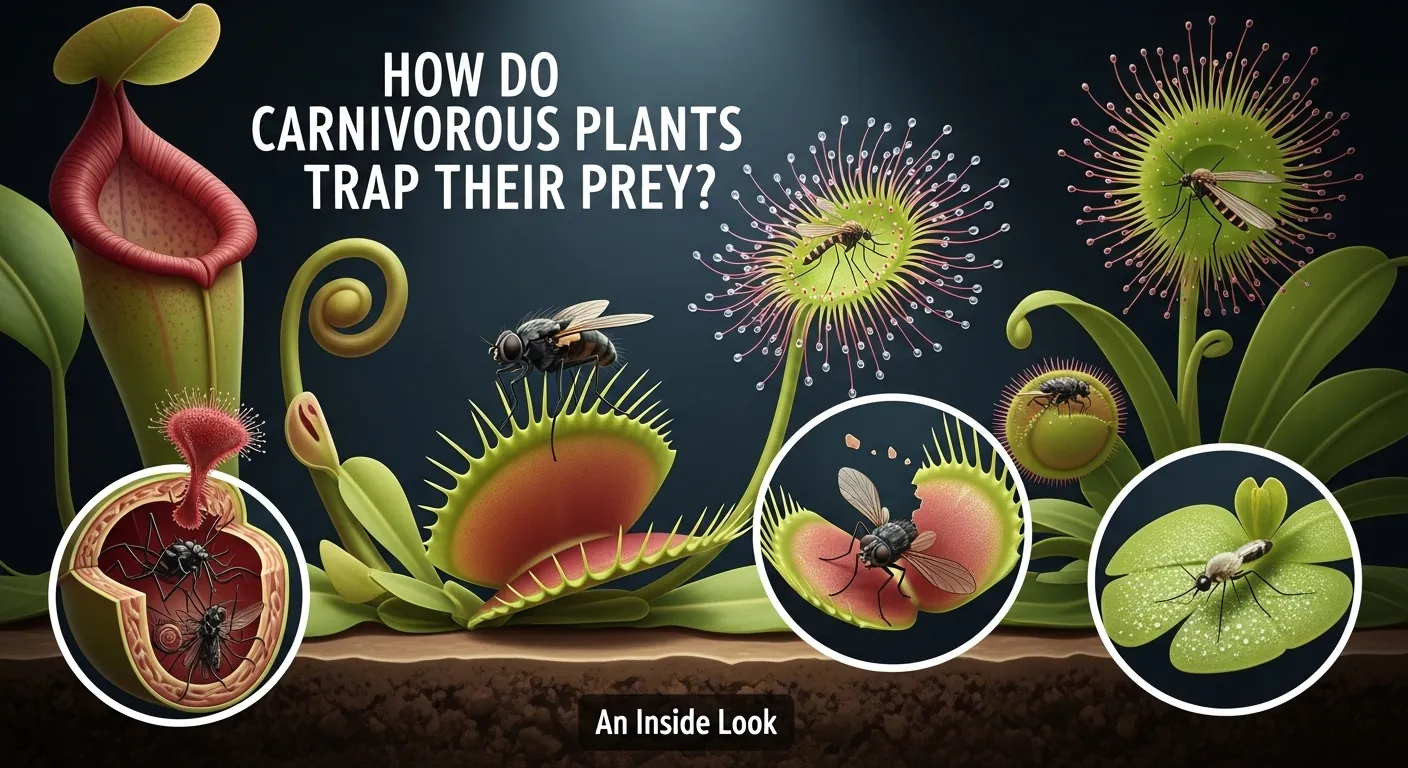
In the vast and strange kingdom of plants, a select few have defied the norms of their kind. While most plants passively draw nutrients from the soil and sun, these botanical predators have evolved to hunt, trap, and consume living creatures. They are the carnivorous plants, masters of adaptation living in some of the world's most nutrient-poor environments. The image of a Venus flytrap snapping shut on an unsuspecting fly is iconic, but it only scratches the surface of their sophisticated hunting prowess. The central question that fascinates botanists and nature lovers alike is, how do carnivorous plants trap their prey with such lethal precision and diversity? This inside look will journey into the intricate and often startling world of their trapping mechanisms. How Do Carnivorous Plants Trap Their Prey? An Inside Look The Fundamental Need: Why Plants Became Predators Before diving into the "how," it's crucial to understand the "why." Carnivorous plants didn't evolve to be predatory out of malice; they did it out of necessity. These remarkable species typically grow in environments like bogs, fens, and waterlogged soils where essential nutrients, particularly nitrogen and phosphorus, are scarce. While they still perform photosynthesis to create energy from sunlight, the soil simply doesn't provide the building blocks they need for proteins, DNA, and other vital molecules. To solve this nutritional deficit, they developed an extraordinary adaptation: carnivory. By capturing and digesting small animals—mostly insects and other arthropods—they supplement their diet, extracting the necessary nitrogen and phosphorus from their prey's bodies. This ability gives them a significant competitive advantage in these harsh habitats, allowing them to thrive where other plants would struggle or perish. It's a perfect example of evolutionary pressure leading to a highly specialized and fascinating survival strategy. This predatory lifestyle is a delicate balancing act. Creating and maintaining complex traps, producing nectar lures, and secreting digestive enzymes all require a significant energy investment. Therefore, for a carnivorous plant, the nutritional benefit gained from capturing prey must outweigh the energetic cost of the hunt. This cost-benefit analysis has driven the evolution of incredibly efficient and diverse trapping mechanisms, each fine-tuned to its environment and preferred prey. An Arsenal of Deception: The Five Main Trapping Mechanisms The world of carnivorous plants is a showcase of evolutionary ingenuity, with over 600 species employing a variety of trapping strategies. While there are countless variations, these methods can be broadly categorized into five fundamental types. Some are passive, relying on their static structure to lure and ensnare victims, while others are active, using rapid movement to catch their prey by surprise. Understanding these five core strategies is key to appreciating the full spectrum of their predatory abilities. These mechanisms are not mutually exclusive in their features; many plants combine elements, such as using adhesive surfaces within a pitfall trap. However, each species typically relies on one primary strategy. The five main trapping mechanisms are: Pitfall Traps: Luring prey into a cavity from which it cannot escape. Flypaper (Adhesive) Traps: Using sticky mucilage to ensnare insects. Snap Traps (Steel Traps): Employing rapid leaf movement to enclose prey. Suction Traps (Bladder Traps): Sucking prey into a bladder with a vacuum. Lobster-Pot Traps: Forcing prey to move towards a digestive organ through a one-way path. The following table provides a quick comparison of these fascinating strategies: Trapping Mechanism Trap Type Example Plant(s) Key Feature Pitfall Trap Passive Pitcher Plants (Nepenthes, Sarracenia) A deep cavity filled with digestive fluid, often with a slippery rim. Flypaper Trap Passive/Active Sundews (Drosera), Butterworts (Pinguicula) Glands that secrete sticky mucilage to trap and suffocate prey. Snap Trap Active Venus Flytrap (Dionaea muscipula) Hinged leaf lobes that snap shut in a fraction of a second. Suction Trap Active Bladderworts (Utricularia) A small bladder that uses a vacuum to suck in small aquatic prey. Lobster-Pot Trap Passive Corkscrew Plant (Genlisea) Underground Y-shaped leaves that guide soil organisms into a digestive chamber. Active Traps: The Art of Rapid Movement Active traps are perhaps the most dramatic, as they involve visible, rapid movement to secure a meal. These mechanisms are energy-intensive but incredibly effective, representing a pinnacle of plant mechanics and sensitivity. They rely on complex biophysical processes to achieve speeds that are almost unbelievable for a member of the plant kingdom. The Snap Trap: A Botanical Bear Trap The quintessential example of an active trap is the Venus flytrap (Dionaea muscipula). Its iconic trap consists of two hinged lobes, fringed with cilia that interlock like teeth when the trap closes. The inner surface of these lobes is dotted with tiny, highly sensitive trigger hairs. For the trap to spring, an insect must touch two different trigger hairs in quick succession or the same hair twice within about 20 seconds. This sophisticated triggering system prevents the plant from wasting energy on false alarms caused by raindrops or falling debris. When the trigger hairs are stimulated, they generate a tiny electrical signal that travels across the leaf lobes. This signal instigates a rapid change in the water pressure within the cells of the leaf's midline—a process known as a change in turgor pressure. The outer cells of the lobes expand quickly while the inner cells contract, causing the leaf's shape to flip from convex (curved outward) to concave (curved inward). This action snaps the lobes shut in as little as 100 milliseconds, a speed too fast for most insects to escape. Once closed, the struggling insect continues to stimulate the hairs, prompting the trap to seal completely and begin releasing digestive enzymes. The Suction Trap: The Fastest Predator on Earth While the Venus flytrap is famous, the title of the fastest hunter in the plant world belongs to the Bladderwort (Utricularia). These mostly aquatic or soil-dwelling plants have hundreds of tiny, pear-shaped bladders, each a highly complex suction trap. The bladder is held under negative pressure—a partial vacuum is created by pumping water out. At the front of the bladder is a small trapdoor sealed shut and surrounded by trigger hairs. When a tiny aquatic