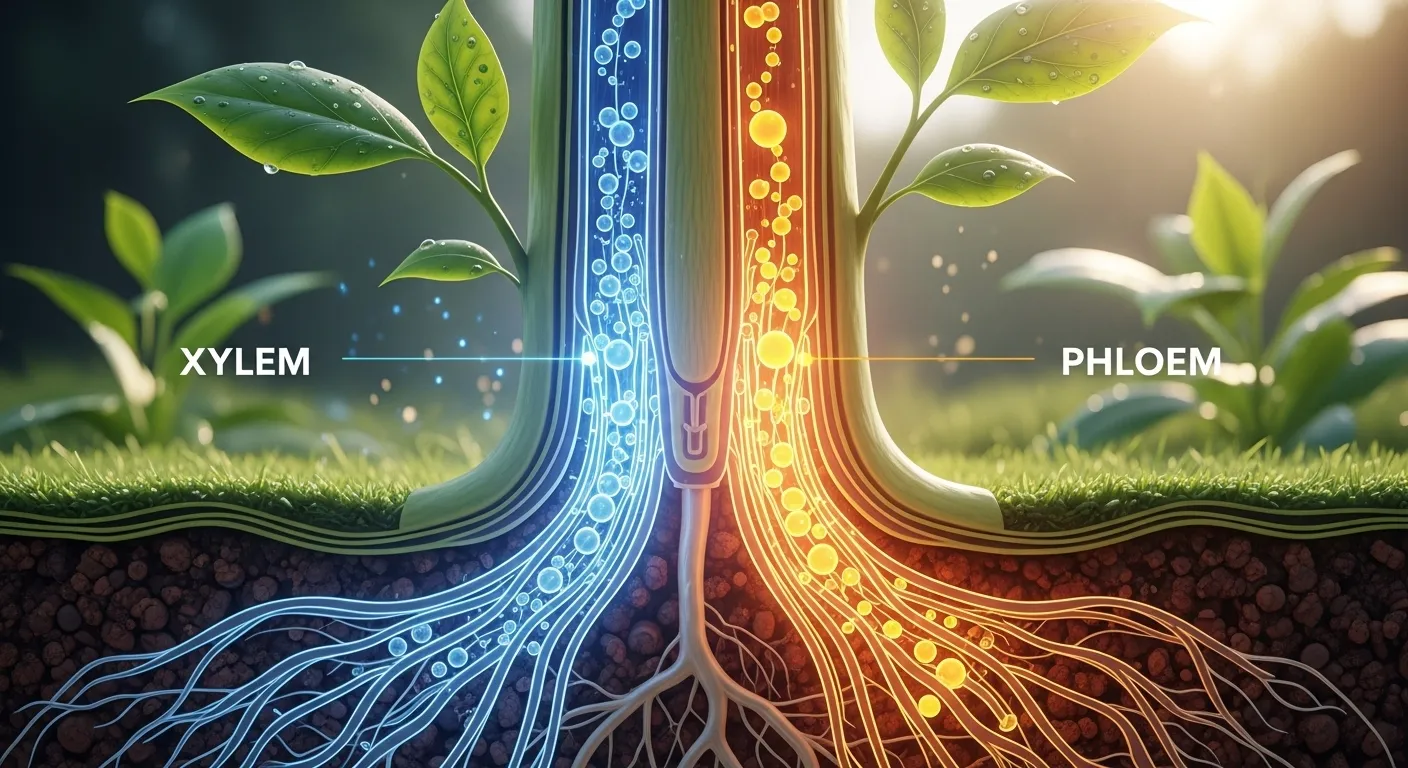
Of course. As an SEO expert, I will create a comprehensive, unique, and engaging article on the function of xylem and phloem that is optimized for search engines and provides long-term value. Here is the article: — Have you ever wondered how a towering redwood tree gets water from its deep roots all the way to its highest leaves, or how the sweet energy produced in a leaf during a sunny afternoon nourishes the fruit on a distant branch? Plants, much like animals, have a sophisticated internal transport system that makes these incredible feats possible. This intricate network is the plant's vascular system, a lifeline composed of two critical tissues. Understanding what is the function of xylem and phloem in plants is the key to unlocking the secrets of their survival, growth, and remarkable efficiency. These two components work in a beautifully coordinated partnership, ensuring every part of the plant receives the water, minerals, and energy it needs to thrive. The Function of Xylem and Phloem in Plants Explained The Vascular System: The Lifeline of a Plant At the heart of a plant's anatomy lies its vascular system, a complex network of conductive tissues that functions as its circulatory system. This system is the plant's internal plumbing, responsible for transporting vital substances over what can be incredible distances—from the finest root hair buried in the soil to the topmost bud reaching for the sun. Without this system, plants would be unable to grow beyond a very small size, as simple diffusion would be insufficient to meet their metabolic needs. The evolution of this efficient transport network was a pivotal moment in the history of life on Earth, allowing plants to conquer land and achieve the massive sizes we see today. This essential system is organized into structures called vascular bundles, which contain both xylem and phloem tissues running side-by-side. You can see these bundles in the veins of a leaf, arranged in a ring within a stem, or clustered in the central core of a root. Their arrangement differs between plant groups (like monocots and dicots), but their fundamental purpose remains the same: to act as a two-way highway for resources. The xylem forms the upward-bound lane, while the phloem constitutes the multidirectional network for nutrient distribution, ensuring a constant and reliable supply chain throughout the organism. The importance of the vascular system cannot be overstated. It directly supports photosynthesis by delivering water to the leaves, provides the building blocks for new growth by distributing sugars, and offers structural rigidity that helps plants stand upright against gravity. It's a dynamic system that responds to the plant's changing needs, whether it's channeling more water on a hot day or sending extra energy to developing fruits and seeds. By understanding the distinct roles of its two main components, xylem and phloem, we can appreciate the elegant engineering that underpins all plant life. Deep Dive into Xylem: The Water Superhighway The primary and most well-known function of the xylem is the bulk transport of water and dissolved minerals from the roots to the rest of the plant. Imagine it as a sophisticated, one-way plumbing system. After water is absorbed by the roots from the soil, it enters the xylem and begins its upward journey through the stem and into the leaves, flowers, and fruits. This water is crucial for many processes, including acting as a key reactant in photosynthesis, maintaining cell turgor (which keeps the plant from wilting), and cooling the plant through evaporation. While water transport is its main job, xylem also plays a vital secondary role: providing structural support. The cells that make up the xylem have thick, rigid walls reinforced with a complex polymer called lignin. This lignification makes the xylem tissue incredibly strong and woody. In fact, what we know as "wood" in trees is almost entirely composed of accumulated xylem. This structural reinforcement helps plants stand tall, resist the forces of wind and gravity, and effectively position their leaves to capture maximum sunlight for photosynthesis. The flow within the xylem is almost exclusively unidirectional, moving from the roots upwards to the shoots. This upward movement is primarily a passive process, meaning the plant does not expend metabolic energy to "pump" the water. Instead, it is driven by physical forces, primarily a phenomenon known as the transpiration pull. This efficient, energy-saving mechanism allows even the tallest trees to move hundreds of liters of water per day from the ground to their canopy, a truly remarkable feat of natural engineering. The Cellular Structure of Xylem Xylem is a complex tissue, meaning it is composed of several different types of cells. The main conducting cells, however, share a unique and fascinating characteristic: they are dead at maturity. When these cells are fully formed, their internal contents—the cytoplasm, nucleus, and vacuole—disintegrate, leaving behind a hollow, continuous tube. This "empty" structure is perfectly designed for its function, as it minimizes obstruction and allows water to flow through with minimal resistance. The thick, lignified cell walls left behind are what provide the structural support. The two primary types of water-conducting cells in the xylem are tracheids and vessel elements. Tracheids are elongated, spindle-shaped cells that are found in all vascular plants, from ferns to conifers and flowering plants. They have tapered ends that overlap, and water moves from one tracheid to the next through small pits in their ajoining walls. Vessel elements are shorter, wider cells that are characteristic of angiosperms (flowering plants). They are stacked end-to-end to form a continuous tube called a vessel. The end walls between vessel elements have perforations or are completely absent, creating an open pipeline that is even more efficient at water transport than tracheids. This evolutionary innovation is one of the reasons for the widespread success of flowering plants. The Mechanism of Water Transport in Xylem The movement of water up the xylem is best explained by the Cohesion-Tension Theory. This model relies on the unique physical properties of water and the structure of the plant.