

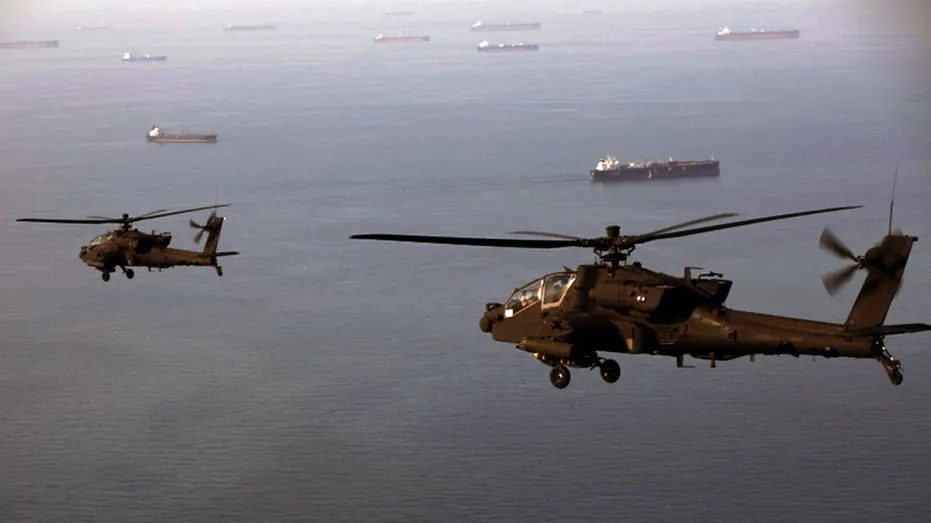
Apache Helicopter Gunships Show Off Power in Hormuz Operations
Apache helicopter gunships showed off their capabilities during a pivotal moment in the Strait of Hormuz. On June 8, a U.S. Army Apache crew faced a critical challenge when an Iranian drone struck the aircraft, embedding itself in the cockpit. Despite the damage, the two-man team survived a nighttime emergency landing, aided by a groundbreaking rescue using a Navy unmanned surface drone. This incident highlighted the Apache’s role in maintaining control over the vital shipping lane, as commercial vessels began resuming transit. President Trump noted progress on June 15, stating, “a lot of lanes are open,” while U.S. Central Command emphasized the availability of pathways for ships not violating the blockade. However, international shippers remain cautious, with BIMCO’s Jakob Larsen warning that risks persist due to lingering threats from rogue drones, missiles, and fast Iranian boats.
A Historic Rescue by Navy Unmanned Surface Drone
The survival of the Apache crew underscored the importance of rapid response systems. During the June 8 event, the drone strike nearly disabled the helicopter, yet the crew’s quick actions combined with the Navy’s unmanned surface drone enabled a successful extraction. Trump praised the operation, remarking, “that bomb was lodged in the helicopter, it didn’t explode. It was on fire, but it didn’t explode.” He added, “those two guys, they knew how to fly, but they got very lucky.” This incident demonstrated the Apache’s adaptability and the integration of cutting-edge technology in modern military operations.
“The Apache—using its current software and systems—is a lethal and adaptable solution to the drone threat.”
Design and Capabilities of the Apache Helicopter
The Apache’s design is tailored for high-intensity environments. Equipped with Hellfire missiles, rockets, and a 30 mm gun, the AH-64E model can engage armored targets from over five miles away. Its cockpit features boron carbide armor, which provides superior protection against .50-caliber rounds, 23 mm shells, and incendiary devices. Blast shields between the tandem seats further enhance survivability during combat. These advancements position the Apache as a critical asset in securing the Strait of Hormuz, where maritime traffic is essential for global energy supply chains.
Strategically, the Apache’s presence signals a shift in U.S. military priorities. Adm. Brad Cooper’s decision to personally fly over the strait emphasized the aircraft’s role in patrolling key choke points. Meanwhile, the growing threat of drones has driven the development of new tactics, such as the Aviation Proximity Explosive (APEX) round. In a March 8 demonstration, the UAE showcased its AH-64E Apaches destroying an Iranian Shahed drone, showcasing the helicopter’s evolving capabilities in countering emerging threats.
As drone warfare intensifies, the Apache has adapted to address this challenge. The APEX round, designed for engagement with small drones and swarms, exemplifies this evolution. U.S. Army crews also achieved 13 out of 14 drone kills in a November training exercise, proving the Apache’s effectiveness. These developments underscore the helicopter’s versatility in modern combat scenarios, where speed, precision, and resilience are paramount.
While the immediate focus is on Iran, the Apache’s operations in the Strait of Hormuz have broader strategic implications. The lessons learned here are being applied to prepare for potential conflicts in the Pacific, where China’s naval expansion could challenge U.S. interests. The Apache’s agility and firepower make it an ideal tool for monitoring and deterring aggression in critical waterways. By protecting commercial shipping, the aircraft reinforces the interconnectedness of military and economic strategies in maintaining global stability.