
Obama Presidential Center Embraces ‘Indigenous’ Land Acknowledgment Amid Controversy
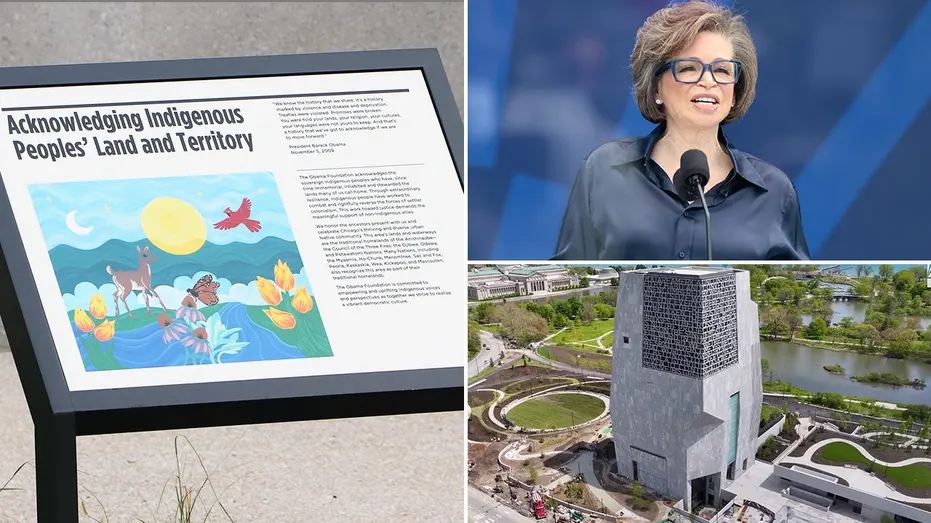
Obama Center embeds Indigenous land message – As the Obama Presidential Center opened on Juneteenth, it unveiled a message that has sparked debate: the idea that the United States was built on land “stolen” from Native American tribes. This acknowledgment, part of a broader ideological push, has drawn both praise and criticism, highlighting the complex history of land ownership in Chicago. At the center of the discussion is a permanent sign located near the facility’s iconic museum tower and the presidential statue, which states that the Obama Foundation recognizes “the sovereign Indigenous peoples who have, since time immemorial, inhabited and stewarded the lands many of us call home.” The sign also notes that Indigenous communities have worked to “combat and rightfully reverse the forces of settler colonialism,” with a reference to a 2009 quote from President Barack Obama on broken treaties, lost lands, and the treatment of Native Americans.
Land Acknowledgment as a Symbol of Historical Recognition
Land acknowledgments have increasingly become a staple at universities, museums, and public events, serving as a way to highlight the historical presence and contributions of Indigenous peoples. While supporters argue these gestures are essential for recognizing the deep ties Indigenous communities have to the land, critics view them as performative or politically motivated. The Obama Foundation’s inclusion of the acknowledgment at its new campus has added a layer of irony, especially given the foundation’s own history with the land it now occupies.
“Treaties were violated. Promises were broken,” Obama said in 2009, reflecting on the displacement of Native American communities and the loss of their ancestral lands. His words are now prominently featured on the sign, which underscores the foundation’s commitment to Indigenous heritage.
The center, located in Jackson Park, sits on public land that was transferred to the Obama Foundation under a controversial agreement. The city of Chicago sold the land for just $10, a deal that critics argue has created a symbolic disconnect between the foundation’s message and its financial arrangements. The 99-year lease requires a one-time payment of $10, but the broader implications of the land transfer have become a focal point of scrutiny.
Political and Legal Battles Over Land Ownership
Illinois GOP Chair Bob Grogan, speaking outside the center last week, challenged the narrative of stolen land, pointing to the site’s historical development. He noted that the land in question was reclaimed after the Great Chicago Fire of 1871 through landfill and public works projects, emphasizing that it was ultimately owned by Chicago taxpayers, not Indigenous tribes. “This land actually was recaptured from the Great Chicago Fire,” Grogan stated. “They took a bunch of rubble and actually created this land. So it has nothing to do with the Native Americans, but it has everything to do with stealing it from the taxpayers of the city of Chicago.”
The land transfer has been part of a protracted legal and political dispute, with opponents questioning the fairness of the deal. The Obama Foundation’s decision to occupy the land, which was once public, has raised concerns about accountability and the use of taxpayer funds. The $10 payment, while symbolic, contrasts sharply with the estimated $1 billion in construction costs and millions in infrastructure improvements required for the project. These expenses have fueled arguments that the center’s development has been at the expense of local taxpayers.
Supporters of the land acknowledgment, however, see it as a necessary step toward addressing historical injustices. They argue that the gesture honors the Indigenous peoples whose lands were once used to build the nation’s capital. Yet, the irony of this message has not gone unnoticed. Critics suggest that the center’s emphasis on Indigenous land rights may overshadow its own role in displacing residents or altering the land’s original purpose.
Subcontractors’ Claims and Economic Disparities
Another layer of controversy has emerged from the center’s construction, as subcontractors who contributed to the project now face financial uncertainty. A recent Fox News Digital investigation found that several firms, including minority-owned businesses, are asserting they are owed millions in unpaid work. This situation has sparked debates about whether the center truly fulfills its promise as an economic catalyst for Chicago’s South Side.
The Obama Foundation had pledged to establish a $470 million endowment fund to ensure long-term financial sustainability for the center. However, with construction costs nearing $1 billion, questions have arisen about whether that commitment will be met. Critics argue that the foundation has not yet fulfilled its obligations, leaving the financial burden on the public and raising concerns about the project’s future viability.
Illinois GOP Chair Bob Grogan further highlighted the economic angle, suggesting that the center’s message of Indigenous land acknowledgment might be a distraction from its impact on Chicagoans. “People here in future years are going to hear about how this land was stolen from the Native Americans,” he remarked. “But underneath, you should all be reading into this, that it was actually stolen from the citizens of Illinois, not from the Native Americans.” His comment reflects a broader argument that the land’s history is more tied to urban development than to Indigenous displacement.
A Broader Controversy and Public Perception
The Obama Presidential Center has been at the center of a larger debate over public spending and the use of city resources. While the foundation framed the project as a symbol of progress and unity, opponents see it as a costly endeavor that has drawn criticism for its financial demands and political symbolism. The land acknowledgment, though intended to highlight Indigenous heritage, has become a point of contention, with some viewing it as an attempt to align the center with progressive narratives at the expense of local taxpayers.
Despite the controversy, the foundation remains committed to its vision of the center as a hub for cultural and educational initiatives. The acknowledgment sign, positioned just steps from the presidential statue, serves as a reminder of the nation’s complex relationship with Indigenous lands. Yet, its presence near the center’s iconic structure has also drawn attention to the irony of a project that celebrates Indigenous heritage while occupying land that was once part of Chicago’s public domain.
The legal battle over the land transfer has been a defining aspect of the center’s development, with advocates for the Obama Foundation defending the deal as a strategic investment in the city’s future. However, the low price paid for the land has raised questions about transparency and whether the city’s taxpayers were adequately compensated. As the center opens its doors, its message of Indigenous land acknowledgment will likely remain a central point of discussion, balancing historical recognition with contemporary financial and political realities.
With the project’s completion and its emphasis on cultural identity, the Obama Presidential Center stands as a symbol of both progress and controversy. Whether it will be seen as a landmark of reconciliation or a monument to contested history may depend on how its various layers—historical, financial, and ideological—are perceived by the public. For now, the land acknowledgment serves as a reminder of the ongoing dialogue about America’s past and its implications for the present.