
Iran names slain supreme leader’s son as successor, in a defiant message to Trump
Iran names slain supreme leader’s son as successor, in a defiant message to Trump
Following the US-Israeli air strikes that claimed the life of former Supreme Leader Ali Khamenei, Iran’s leadership has appointed his son Mojtaba Khamenei to the top post. This move marks a continuation of the family dynasty, despite the 1979 revolution that initially sought to break the cycle of father-to-son succession. The 88-member Assembly of Experts, tasked with selecting the next supreme leader, has now cemented the hardliners’ influence by elevating Mojtaba to the role his father held for almost four decades.
The decision to name Mojtaba as the third supreme leader was framed as a show of resistance against American pressure. Trump had previously labeled the figure as “unacceptable,” yet Iran’s leaders appear undeterred, reinforcing their stance with a unified front. The regime’s strategy involves consolidating power under the Revolutionary Guards, positioning Mojtaba as the central figure in this renewed alignment.
“Bravely fighting alongside the revolution’s defenders,”
state media highlighted in a four-minute documentary released shortly after the announcement. The film portrayed Mojtaba’s life, emphasizing his humble beginnings, seminary education, and his active participation in the Iran-Iraq war at age 17. By showcasing his early experiences, the media aimed to underscore his readiness to lead, countering criticisms that he lacked the scholarly depth traditionally associated with a supreme jurisprudent.
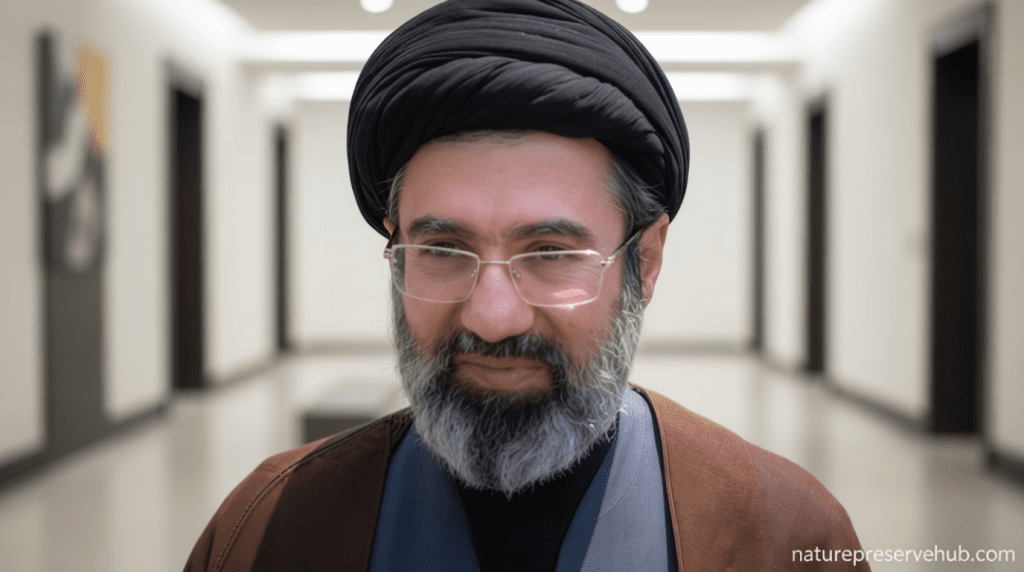
Despite his low public profile, Mojtaba has been deeply embedded in the regime’s inner workings. His marriage to Zahra, daughter of Gholam Haddad Adel—a former parliament speaker and close Khamenei associate—strengthens his ties to the leadership. While he did not attain the rank of Mujtahid, he has cultivated relationships within the Revolutionary Guards and economic networks that sustain the system. State media has resorted to AI-generated visuals to fill gaps in his public presence since his elevation.
Observers note Mojtaba’s subtle yet impactful role in shaping Iran’s political landscape. His influence was evident during the 2005 presidential elections, where he supported Mahmoud Ahmadinejad’s candidacy against Akbar Hashemi Rafsanjani. The 2009 protests, which challenged Ahmadinejad’s re-election, revealed his growing political stature. Demonstrators even chanted, “Mojtaba may you die so you don’t assume the leadership role,” underscoring his significance.
In 2019, Mojtaba was sanctioned by the US Treasury for his collaboration with the Revolutionary Guards’ commander, accused of advancing his father’s “destabilizing regional ambitions and oppressive domestic objectives.” The appointment signals a shift toward maintaining the regime’s hardline approach, even as Iran grapples with internet and communications restrictions following the recent attack.
