
Syria walks back Damascus alcohol ban after outcry from residents
Syria walks back Damascus alcohol ban after outcry from residents
Damascus authorities have reversed a recent alcohol prohibition in response to public backlash and claims of religious bias. The initial directive, announced on Monday, restricted the sale of alcoholic beverages in restaurants and nightclubs citywide, with exceptions granted to Christian districts such as Bab Touma, Qassaa, and Bab Sharqi.
The decision referenced widespread local concerns and argued the ban sought to “eradicate behaviors conflicting with societal norms.” By Sunday, after facing protests and criticism, the governorate released a clarification that adjusted the restrictions. It outlined exceptions for tourism-related sales, permitting alcohol in hotels, restaurants, and other specified locations.
The Damascus Governorate apologises to our people in Bab Touma, Qassaa and Bab Sharqi for the misunderstanding that arose from the decision, which was circulated inappropriately,” said the statement.
The clarification also extended an apology to Christian residents, acknowledging the decision’s potential to be seen as sectarian and discriminatory. “These areas are considered part of the beating heart of the capital and constitute an icon of its identity and culture. The Governorate will reconsider the three areas mentioned in the decision in a way that does not offend any of its constituent groups,” the statement added.
Following the ousting of Bashar al-Assad in December 2024, the government under President Ahmed al-Sharaa, which previously included the dissolved Hay’at Tahrir al-Sham—a former al-Qaeda faction—has generally avoided imposing social constraints on citizens. Yet, recent policies such as a January restriction on female public sector workers’ makeup and a previous mandate for full-body swimsuits on beaches have sparked worries about a shift toward stricter social controls.
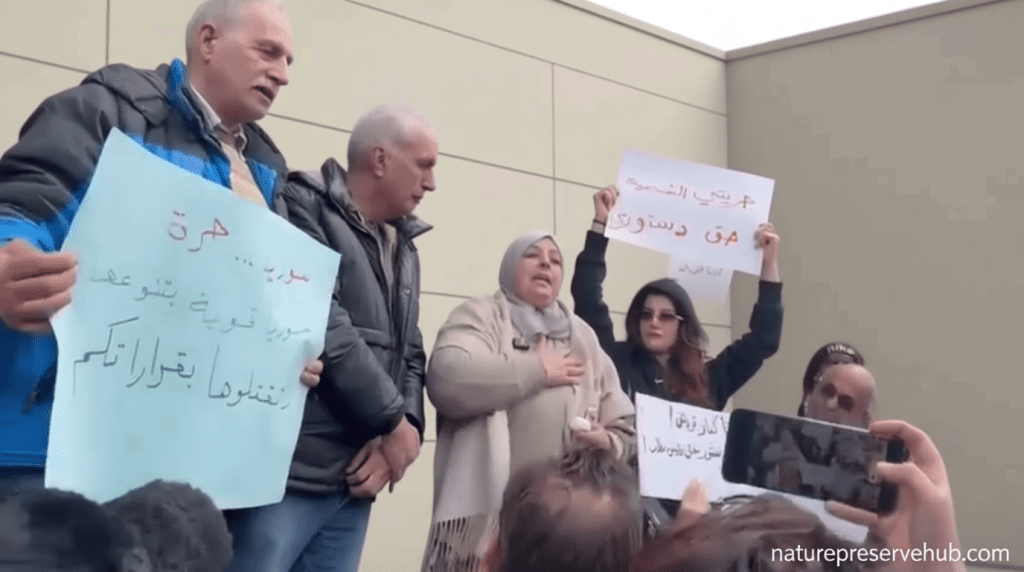
While most Syrians are conservative Sunni Muslims who avoid alcohol due to religious observance, secular Sunnis and various minority groups perceive the ban as a challenge to personal freedoms. Sunday’s demonstration in Bab Touma highlighted broader frustrations, with alcohol restrictions being one of the key issues.
Restricting the sale of alcohol to predominantly Christian areas could make these regions vulnerable to terrorist assaults, considering the history of Christian persecution in Syria,” the statement warned.
The interim administration has faced challenges in stabilizing internal unrest, countering Israeli strikes, and navigating complex ties with former allies and adversaries. In October, the government held parliamentary elections in which Sharaa hand-picked a third of the seats, while the remaining two-thirds were chosen by local committees made up of government appointees. The process bypassed the Druze-majority Sweida province and the country’s Kurdish-held northeast, leaving their 32 seats empty.
According to a temporary constitution announced in March, the parliament will exercise legislative functions until a permanent constitution is adopted and new elections can be held at the end of a five-year transitional process. The new interim authorities say popular elections are unworkable in the wake of Syria’s 13-year war, which saw hundreds of thousands killed and millions displaced both internally and externally.
