
The Life Cycle of a Butterfly for Kids: A Simple Guide
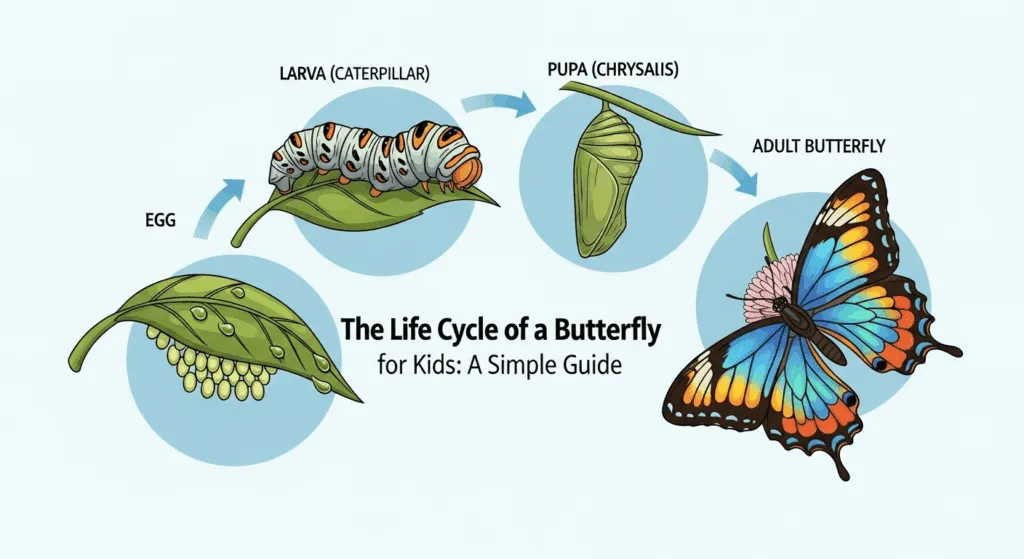
Have you ever seen a beautiful butterfly fluttering past a flower and wondered where it came from? It wasn’t just born as a butterfly! Butterflies go through an incredible and magical change called metamorphosis. It’s like a real-life fairy tale of transformation, right in our own backyards. Understanding this amazing journey is one of the most exciting parts of learning about nature. This simple guide to the life cycle of a butterfly for kids will take you through every amazing step, from a tiny, hidden egg to a magnificent winged wonder. Let’s explore this incredible process together!
What is a Life Cycle? A Big Word for a Big Change
The term "life cycle" might sound very scientific, but it’s actually a simple idea. Think of it like a circle or a story that repeats itself. Every living thing, from the smallest bug to the biggest whale, has a life cycle. It describes how a creature is born, how it grows and changes, how it has babies of its own, and how the whole process starts all over again. For you, it started as a baby, you grow into a kid, then a teenager, and one day you’ll be an adult.
For some animals, like butterflies, this process is extra special. They go through a complete transformation called metamorphosis. This is a Greek word that means "to change form." Instead of just getting bigger, a butterfly completely changes its body at different stages. It starts as one type of creature and ends as a completely different one. This process is one of nature’s most fascinating tricks, and it’s the key to understanding the amazing journey of a butterfly.
The butterfly life cycle is a perfect example of complete metamorphosis. It has four very distinct and different stages. Each stage looks totally different from the one before it and has a unique purpose. The four stages are: the egg, the larva (which we call a caterpillar), the pupa (which we call a chrysalis), and finally, the adult butterfly. Let's dive into each of these incredible stages to see how a crawling creature becomes a flying jewel.
Stage 1: The Tiny Egg – Where It All Begins
Everything starts with a tiny butterfly egg. A mother butterfly is very careful about where she lays her eggs. She doesn’t just lay them anywhere! She finds a very specific type of plant, called a host plant, to lay them on. The eggs can be round, oval, or even a bit ridged, and they are often so small that you would need to look very closely to find them. She might lay a single egg or a cluster of them, usually on the underside of a leaf to keep them safe from predators and the hot sun.
The reason the mother butterfly is so picky about the plant is that the egg is like a pre-packed lunch box for her baby. When the baby caterpillar hatches, its very first meal will be the leaf it was born on. Different types of butterflies have different favorite host plants. For example, the famous Monarch butterfly will only lay its eggs on milkweed plants, because that is the only food Monarch caterpillars can eat. The mother butterfly uses her feet to "taste" the leaves to make sure she has found the perfect spot for her babies to begin their life.
After a few days or sometimes a couple of weeks, depending on the weather and the type of butterfly, the egg is ready to hatch. A tiny caterpillar chews its way out of the eggshell. Often, its first meal is not the leaf, but its own eggshell, which is full of important nutrients to give it a strong start. From this moment on, the little caterpillar has only one main job in life, and it’s a job it does very, very well.
Finding Butterfly Eggs in Your Garden
If you want to be a nature detective, you can try to find butterfly eggs in your own garden or a nearby park. The best place to start looking is on the host plants for butterflies common in your area. For example, if you have milkweed, check the undersides of the leaves for the tiny, cream-colored eggs of a Monarch. If you have parsley, dill, or fennel, you might find the small, yellow, round eggs of a Black Swallowtail butterfly.
Remember to be very gentle when you are looking. The eggs are delicate and can be easily damaged. It’s best to just observe them without touching them. You can take a magnifying glass with you to get a closer look. Watching an egg in the same spot for several days is a great way to see if you can spot the tiny caterpillar when it finally hatches. It’s a patient game, but finding one is an amazing reward!
Stage 2: The Caterpillar – The Eating Machine
Once it hatches from the egg, the creature is now in its larval stage, which we all know as the caterpillar. A caterpillar's life mission is simple: eat and grow. And that is exactly what it does, all day, every day. It munches on the leaves of its host plant, growing at an incredible speed. A caterpillar can grow to be more than 1,000 times its original size from when it hatched! This would be like a human baby growing to the size of a school bus in just a couple of weeks.
Because it grows so fast, a caterpillar’s skin doesn't grow with it. So, what does it do? It molts! Molting means the caterpillar sheds its old, tight skin, much like you outgrow your clothes. Underneath, it already has a new, bigger skin ready. A caterpillar will molt several times during this stage, and the periods between molting are called instars. Each time it molts, it gets bigger and may even change its colors or patterns slightly.
This stage is the longest part of the butterfly's life, often lasting for two to five weeks. During this time, the caterpillar is very vulnerable to predators like birds, spiders, and other insects. To protect themselves, caterpillars have developed amazing defenses. Some use camouflage to blend in perfectly with the leaves and twigs around them. Others have bright, bold colors that act as a warning to predators, signaling that they are poisonous or taste terrible. The Monarch caterpillar, for instance, gets toxins from the milkweed it eats, making it a nasty meal for a hungry bird.
Amazing Caterpillar Facts
Caterpillars may look simple, but they are fascinating creatures. If you look closely, you’ll see they have many pairs of legs. The first three pairs at the front are its "true legs," which will one day become the legs of the adult butterfly. The other fleshy legs along its body are called "prolegs." These are not real legs but are stumpy, suction-cup-like appendages that help the caterpillar grip onto leaves and stems as it crawls and eats.
The sheer amount a caterpillar eats is mind-boggling. In its short life as a larva, a single caterpillar can eat hundreds of leaves. All this eating is for a very important reason. It’s not just growing bigger; it's storing up all the energy and nutrients it will need for the next incredible stage of its life, where it won’t be able to eat at all. It’s basically saving up energy for the most magical transformation in the animal kingdom.
What Do Caterpillars Eat?
As we mentioned, caterpillars are incredibly picky eaters. This is a very important survival strategy. A mother butterfly lays her eggs on a specific host plant because that is the only food her caterpillars can digest and thrive on. They can't just decide to crawl over to another plant for a different snack. This is why having the right native plants in a garden is so crucial for supporting local butterfly populations.
For example, the beautiful Eastern Tiger Swallowtail caterpillar feeds on the leaves of tulip trees and wild cherry trees. The Painted Lady butterfly, one of the most widespread butterflies in the world, is a little less picky and its caterpillars will eat thistle, mallow, and hollyhock. If you want to attract specific butterflies to your yard, the best thing you can do is to plant the host plants their caterpillars need to eat. It's the first and most important step in creating a butterfly-friendly habitat.
Stage 3: The Pupa – The Magical Transformation Chamber
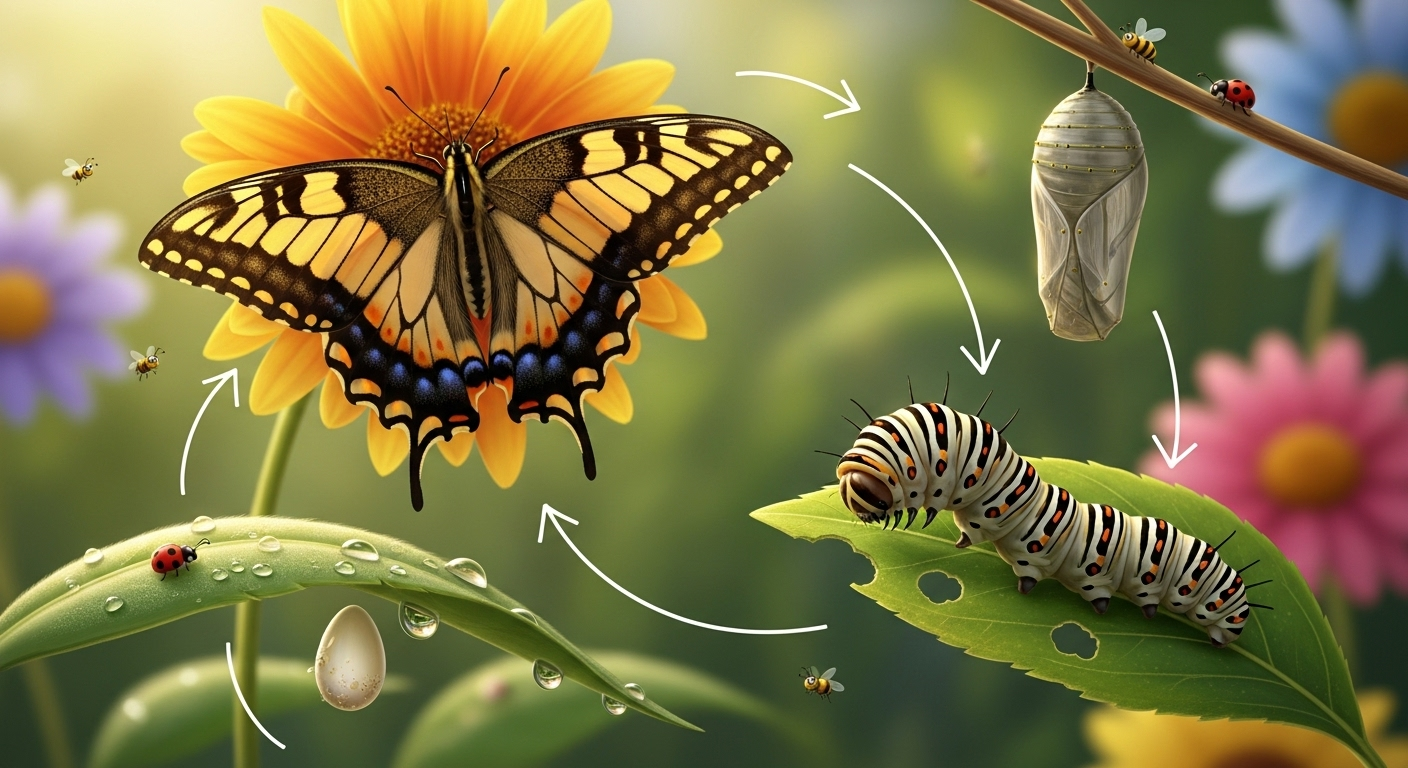
After all that eating and growing, the caterpillar reaches its full size and knows it’s time for the next big step. It will stop eating and find a safe, hidden spot. This might be on a sturdy branch, under a leaf, or on the side of a wall. It will then hang upside down, often in a 'J' shape, and prepare for its most mysterious change. The caterpillar sheds its skin one last time, but this time, something very different is underneath. It’s not a bigger caterpillar; it’s a chrysalis.
The chrysalis is the pupa stage of a butterfly. It’s a hard, protective casing that protects the pupa inside. It is very important to know that butterflies make a chrysalis, while moths make a cocoon. A cocoon is spun from silk, while a chrysalis is the hardened skin of the caterpillar itself. The chrysalis can be beautifully camouflaged. Some look exactly like a dead, dried-up leaf, while others, like the Monarch’s, are a stunning green with tiny gold dots.
From the outside, the chrysalis looks completely still, as if nothing is happening. But inside, it's a whirlwind of activity! This is where the real magic of metamorphosis occurs. Inside the chrysalis, the caterpillar's body is completely breaking down into a kind of "caterpillar soup." From this soup, special cells called imaginal discs start to grow and rearrange to form all the parts of the adult butterfly—the delicate wings, the long antennae, the new legs, and the straw-like proboscis for sipping nectar. It's a complete re-building process from the ground up, all hidden away inside this protective case.
| Feature | Chrysalis (Butterfly) | Cocoon (Moth) |
|---|---|---|
| What is it? | The hardened body of the pupa itself. | A woven casing made of silk spun by the caterpillar. |
| Texture | Smooth, hard, and shell-like. | Soft, fuzzy, and silky. |
| Attachment | Often hangs from a surface. | Can be wrapped in a leaf, buried, or attached to a twig. |
| Inhabitant | The pupa of a butterfly. | The pupa of a moth. |
Stage 4: The Butterfly – Taking Flight!
After about one to two weeks in the chrysalis, the transformation is complete. If you watch a chrysalis closely near the end of this stage, you might see it change color or even see the patterns of the butterfly’s wings through the shell. When the time is right, the chrysalis shell will split open, and the adult butterfly will begin to wiggle its way out. This is a slow and difficult process, and the struggle helps the butterfly build strength.
When the butterfly first emerges, it looks a bit strange. It's big and puffy, and its wings are crumpled up and wet, like a wrinkled piece of paper. The butterfly is very vulnerable at this moment. It will hang upside down from the empty chrysalis shell and begin to pump a special fluid, called hemolymph, from its body into the veins of its wings. This is what causes the wings to slowly expand, flatten, and straighten out, just like blowing up a balloon.
It can take an hour or more for the wings to fully expand and harden. During this time, the butterfly must remain perfectly still. Once its wings are dry and rigid, it's ready for its very first flight. The butterfly, now a creature of the air, will take off to begin its new life. Its primary jobs now are to fly, drink nectar from flowers for energy, and find a mate to reproduce. The female will then lay her eggs on a host plant, and the life cycle of a butterfly for kids that we've been exploring will begin all over again.
What Do Butterflies Do?
Adult butterflies are not just beautiful to look at; they are also incredibly important for the environment. As they travel from flower to flower drinking sweet nectar with their straw-like tongues (called a proboscis), they get covered in pollen. When they visit the next flower, some of that pollen rubs off. This process is called pollination, and it's how plants are able to make seeds and grow new plants. Butterflies are important pollinators for many of the flowers and food we enjoy.
Butterflies also have incredible senses. They can see a wider range of colors than humans can, including ultraviolet light, which helps them find nectar in flowers. They also have a sense of smell and "taste" through their antennae and feet. A female butterfly will drum her feet on a leaf to "taste" it and make sure it's the correct host plant for her eggs. It's how she knows her babies will have the food they need to survive.
How You Can Help Butterflies
Butterflies face many challenges, including the loss of their habitats and the use of pesticides in gardens and farms. But the good news is that we can all do simple things to help them thrive. Creating a safe and welcoming space for butterflies in your own backyard or on a balcony is a fun and rewarding project that helps nature.
Here are a few easy ways you can help butterflies:
- Plant a Butterfly Garden: Choose a sunny spot and plant flowers that are rich in nectar. Butterflies love colorful flowers like coneflowers, zinnias, and butterfly bush.
- Don't Forget Host Plants: This is the most important step! Find out which butterflies live in your area and plant their specific host plants. For Monarchs, plant milkweed. For Swallowtails, plant dill, fennel, or parsley. Without host plants, butterflies cannot complete their life cycle.
- Avoid Pesticides: Pesticides and herbicides can be very harmful to butterflies, caterpillars, and other helpful insects. Try to use natural, organic methods to control pests in your garden.
- Provide a Water Source: Butterflies need water, but they can't drink from deep pools. A shallow dish filled with sand or pebbles and a little bit of water creates a "puddling station" where they can safely land and drink the minerals they need.
Frequently Asked Questions (FAQ)
Q: How long does the entire life cycle of a butterfly take?
A: It varies a lot! For some species like the Cabbage White, the entire cycle from egg to adult can be as short as 3-4 weeks in warm weather. For others, like the Monarch, it takes about a month. Some butterflies that live in colder climates can even spend the entire winter in their chrysalis stage, meaning their life cycle takes almost a year to complete.
Q: What is the difference between a butterfly and a moth?
A: They are close relatives, but there are a few easy ways to tell them apart. Butterflies usually have thin antennae with little clubs at the end, while moths have feathery or hair-like antennae. When they rest, butterflies typically hold their wings folded up together vertically over their bodies, while moths rest with their wings spread out flat. And as we learned, butterflies form a chrysalis, while most moths spin a silk cocoon.
Q: Do all caterpillars turn into butterflies?
A: No, only the caterpillars of the insect order Lepidoptera that belong to the butterfly families will turn into butterflies. The other caterpillars from this order will turn into moths. So, every butterfly starts as a caterpillar, but not every caterpillar will become a butterfly!
Q: How long do adult butterflies live?
A: The lifespan of an adult butterfly can be surprisingly short. Many smaller butterflies only live for about a week, just long enough to mate and lay eggs. Some larger butterflies can live for a few weeks. One famous exception is the migratory generation of the Monarch butterfly, which can live for up to nine months as it makes its incredible journey from Canada and the US all the way down to Mexico for the winter.
Conclusion
The life cycle of a butterfly is one of nature's most enchanting stories. From a tiny egg on a leaf, to a hungry, crawling caterpillar, to the mysterious and still chrysalis, and finally to the breathtaking, flying butterfly, each stage is a miracle of transformation. This process of metamorphosis shows us how much change is possible and reminds us of the hidden wonders happening all around us every single day. The next time you see a butterfly gracefully dancing in the air, you’ll know the amazing journey it took to get there. Now, why not go outside and see if you can find a piece of this magical cycle for yourself?
***
Summary
This article, "The Life Cycle of a Butterfly for Kids: A Simple Guide," provides a comprehensive yet easy-to-understand exploration of butterfly metamorphosis, designed for a young audience and their parents. It begins by explaining the concepts of a life cycle and complete metamorphosis in simple terms. The article then details the four distinct stages of a butterfly's life: the Egg, the Larva (caterpillar), the Pupa (chrysalis), and the Adult butterfly. Each stage is described with a focus on its unique purpose, from the caterpillar's role as an "eating machine" to the magical transformation that occurs inside the seemingly dormant chrysalis. The guide includes practical tips for finding eggs, fascinating facts about caterpillars, a clear distinction between a chrysalis and a cocoon (supported by a table), and an explanation of the adult butterfly's role as a pollinator. The article also offers actionable advice on how to help butterflies by creating butterfly-friendly habitats and concludes with an FAQ section to answer common questions. The overall goal is to inspire curiosity and a deeper appreciation for the natural world by demystifying this incredible biological process.
