
What Causes Habitat Loss and Fragmentation? An Expert Guide
Of course. As an SEO expert, I will create a unique, engaging, and in-depth article that adheres to the latest SEO best practices, following all your instructions precisely.
Here is the SEO-optimized article:
The rich tapestry of life on Earth depends on a mosaic of healthy, interconnected ecosystems. From the densest jungles to the most vibrant coral reefs, these habitats provide shelter, food, and breeding grounds for millions of species. However, this natural infrastructure is under unprecedented threat. The very "homes" that wildlife depends on are shrinking and shattering at an alarming rate. Understanding what causes habitat loss and fragmentation is the first critical step toward addressing one of the most significant environmental challenges of our time: the global biodiversity crisis. This guide will provide an expert analysis of the primary drivers, their complex interactions, and the profound consequences for our planet.
Understanding the Core Concepts: Habitat Loss vs. Fragmentation
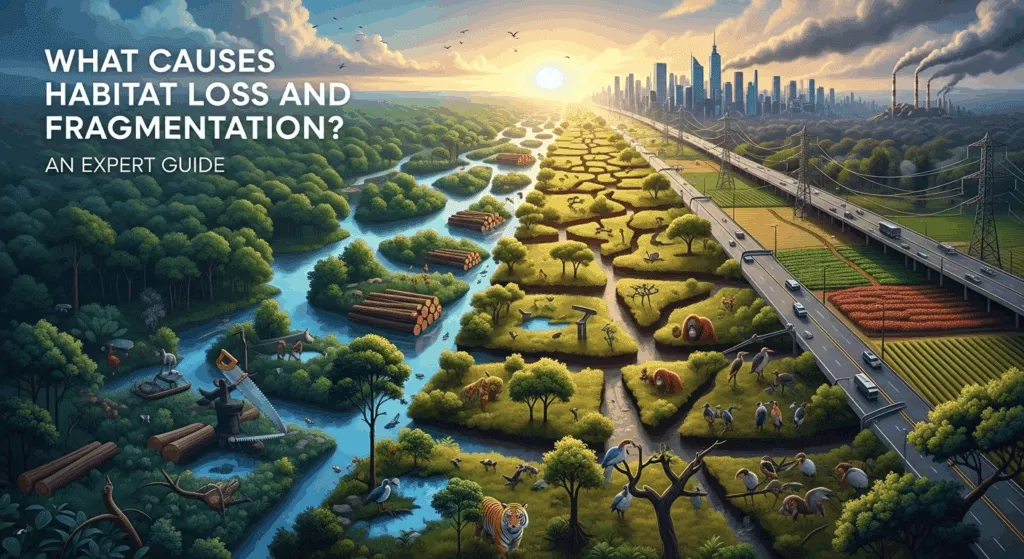
Before delving into the causes, it is essential to distinguish between two related but distinct terms: habitat loss and habitat fragmentation. Habitat loss, in its simplest form, refers to the outright destruction of a natural habitat, rendering it completely unable to support the species that once lived there. When a forest is clear-cut for a farm or a wetland is drained for a housing development, the result is a total loss of that specific habitat. This is a measure of a reduction in the quantity of available living space for wildlife.
In contrast, habitat fragmentation is a more subtle but equally pernicious process. It occurs when a large, contiguous habitat is broken up into smaller, isolated patches, often separated by human-made landscapes like roads, farms, or cities. While the total area of the habitat might not be completely gone, it is no longer a single, functional unit. This process dramatically increases the "edge effect," where the boundaries between the natural habitat and the human-altered landscape create conditions (like more wind, sunlight, and a higher risk of invasive species and predators) that degrade the quality of the remaining habitat from the outside in.
The distinction is crucial because the impacts are different. While habitat loss directly reduces the carrying capacity of an ecosystem, fragmentation isolates populations. This isolation prevents genetic exchange, making populations more vulnerable to disease and inbreeding. It also restricts the movement of animals, preventing them from finding mates, accessing seasonal food sources, or migrating to more suitable climates. In many cases, loss and fragmentation occur simultaneously, creating a devastating one-two punch that accelerates the decline of biodiversity.
The Primary Driver: Agricultural Expansion
Globally, the single largest driver of habitat loss and fragmentation is the conversion of natural land for agricultural purposes. The ever-growing human population requires vast amounts of food, fiber, and biofuels, and our current agricultural systems demand immense tracts of land to meet this demand. This expansion relentlessly encroaches upon forests, grasslands, and wetlands, replacing complex, biodiverse ecosystems with simplified, human-managed landscapes. The United Nations estimates that agriculture is the direct threat to over 85% of the species at risk of extinction.
This process takes several forms, from small-scale subsistence farming to massive industrial operations. However, the most destructive forms are often tied to global commodity markets. The demand for products like palm oil, soy, beef, and cocoa has fueled deforestation on a catastrophic scale in tropical regions, which are the planet's most biodiverse areas. This conversion is not just about clearing trees; it involves altering soil chemistry with fertilizers and pesticides, diverting massive quantities of water for irrigation, and creating a landscape that is hostile to most native wildlife.
The Impact of Monoculture Farming
Monoculture is the agricultural practice of growing a single crop species over a wide area, year after year. Think of endless fields of corn, wheat, or soybeans. While this method is highly efficient from a harvesting perspective, it is devastating for biodiversity. Natural ecosystems are characterized by diversity, but a monoculture field is essentially a biological desert. It offers only one type of food and shelter, which is often chemically protected, making it unsuitable for most insects, birds, and mammals.
Furthermore, these systems create a cascade of environmental problems that degrade surrounding habitats. They eliminate the variety of plants that support native pollinators like bees and butterflies, which are essential for the reproduction of wild flora. Monocultures also tend to deplete soil nutrients, leading to a greater reliance on synthetic fertilizers. Runoff from these fields carries excess nitrogen and phosphorus into nearby rivers and lakes, causing algal blooms (eutrophication) that suffocate aquatic life, effectively destroying freshwater habitats far from the farm itself.
The Footprint of Livestock Ranching
The production of meat and dairy products has an enormous land footprint, making it a major cause of habitat loss, particularly deforestation. In South America, it is estimated that over 70% of the deforestation in the Amazon rainforest has been for cattle ranching. Vast areas of forest are burned or cleared to create pasture for grazing. This not only destroys the habitat for countless species of monkeys, jaguars, birds, and insects but also releases massive amounts of carbon into the atmosphere.
Beyond the initial clearing, livestock ranching continues to degrade the land. Overgrazing can lead to soil compaction and erosion, which prevents the natural regeneration of vegetation. The immense water consumption required for both the animals and the crops grown to feed them puts a strain on local water resources, altering the hydrology of entire regions. The waste produced by large concentrations of livestock can also pollute nearby water sources, further contributing to the degradation of aquatic ecosystems.
Urbanization and Infrastructure Development
As the global population becomes increasingly concentrated in cities, urban sprawl and the infrastructure required to support it have become significant drivers of habitat destruction. The expansion of cities, suburbs, and industrial zones directly consumes natural and semi-natural habitats, paving over fields, filling in wetlands, and clearing forests. This conversion is often permanent, leaving little to no chance for the ecosystem to recover.
The impact, however, extends far beyond the physical footprint of the buildings. Urban areas are sources of light, noise, and chemical pollution that can disrupt the behavior and reproductive cycles of wildlife in adjacent habitats. Furthermore, the demand for resources to build and power these cities—such as water, timber, and aggregate—drives habitat loss in distant locations. Essentially, cities project a "halo" of environmental impact that reaches far beyond their administrative boundaries.
The Barrier Effect of Roads and Railways
Linear infrastructure, such as roads, highways, and railways, is a primary agent of habitat fragmentation. While a road may seem like a small line on a map, to many animals, it is an impassable barrier. This barrier splits large, cohesive populations into smaller, isolated sub-populations. This genetic isolation increases the risk of inbreeding depression and makes the species less resilient to environmental changes.
Furthermore, roads are a major source of direct mortality for wildlife. The term roadkill represents a significant threat to the populations of many species, from amphibians and reptiles to large mammals like deer and bears. Roads also act as conduits for invasive species, allowing non-native plants and animals to penetrate deep into natural areas. To mitigate this, some modern infrastructure projects are incorporating wildlife corridors—overpasses or underpasses designed to allow animals to cross safely—but these are still the exception rather than the rule.
The Transformation of Rivers by Dams
Dams and water diversion projects are built to generate hydroelectric power, provide water for irrigation, and control floods. However, they fundamentally re-engineer river ecosystems, causing both habitat loss and fragmentation on a massive scale. When a dam is built, it floods a vast area upstream, drowning terrestrial and riverine habitats to create a reservoir. This is a direct and total loss of the original ecosystem.
Downstream, the impacts are just as severe. Dams alter the natural flow, temperature, and sediment load of the river. This disrupts the life cycles of fish and other aquatic organisms that have adapted to specific seasonal flows. For migratory fish like salmon or sturgeon, a dam is an insurmountable barrier that cuts them off from their spawning grounds, leading to population collapse. The fragmentation of river systems is a major contributor to the global decline of freshwater biodiversity, which is disappearing at an even faster rate than terrestrial or marine biodiversity.
The Pervasive Impact of Resource Extraction
The human appetite for natural resources—from timber and minerals to fossil fuels—is another major catalyst for habitat loss and fragmentation. These extractive industries often involve large-scale landscape alteration, leading to direct habitat destruction and long-term contamination that renders land unusable for decades or even centuries.
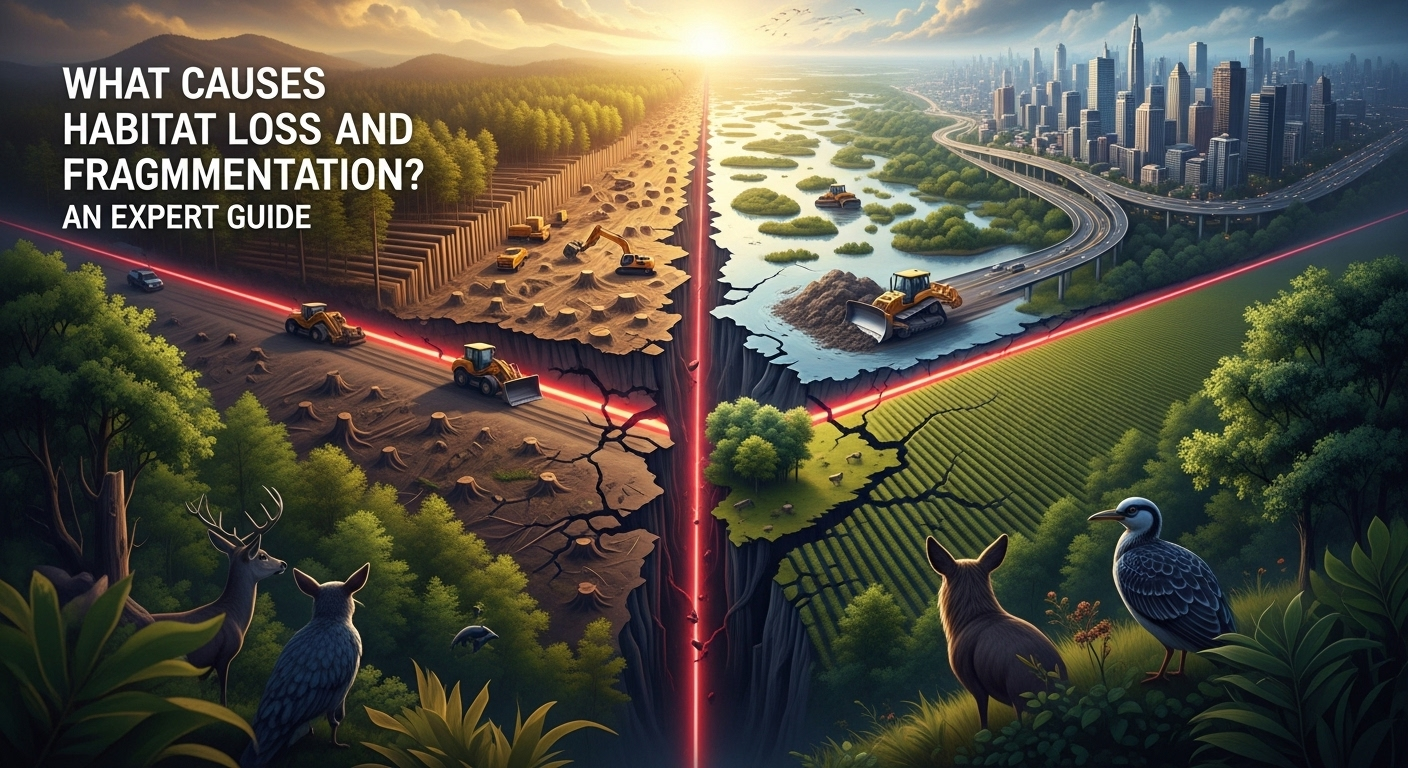
The methods used in resource extraction are often highly destructive. Mining operations, in particular, can be devastating. Mountaintop removal mining, for instance, literally blows the tops off mountains to access coal seams, burying adjacent valleys and headwater streams under tons of rock and debris. Open-pit mining for minerals like copper or gold creates massive craters and produces immense quantities of waste rock, which can leach acid and heavy metals into the surrounding environment, poisoning soil and water.
Deforestation for Timber and Pulp
While not all logging is inherently destructive, many common practices lead to severe habitat degradation and loss. Clear-cutting, the practice of removing every tree in a given area, is the most damaging. It eliminates the entire forest canopy at once, dramatically altering light levels, temperature, and humidity on the forest floor. This instantly destroys the habitat for species dependent on mature forest structures, such as certain birds, arboreal mammals, and fungi.
Even selective logging, which removes only specific high-value trees, can cause significant fragmentation. The construction of logging roads to access and transport timber opens up previously inaccessible forest interiors. These roads fragment the habitat, increase erosion, and facilitate access for hunters, poachers, and settlers, leading to further deforestation and degradation. The loss of old-growth forests, which have unique structural complexity and support specialized species, is a particularly critical conservation concern.
Mining and Fossil Fuel Exploration
The quest for fossil fuels and minerals drives habitat destruction in some of the world's most sensitive ecosystems, from the Arctic tundra to the deep sea. Oil and gas exploration requires the construction of well pads, pipelines, and access roads, all of which fragment the landscape. The inevitable spills and leaks associated with this industry can cause catastrophic, long-lasting pollution. The 2010 Deepwater Horizon oil spill, for instance, caused immense damage to marine and coastal habitats across the Gulf of Mexico.
Mining's legacy often includes long-term pollution. Acid mine drainage—the outflow of acidic water from metal or coal mines—can sterilize streams for miles, killing all fish and aquatic insects. The chemicals used in processes like gold extraction, such as cyanide and mercury, are highly toxic and can contaminate vast areas if containment fails. This chemical footprint ensures that even after a mine closes, the land remains a "toxic trap" and an ecological dead zone for a very long time.
| Primary Driver | Key Activities | Primary Impacts on Habitat | Example Region / Species Affected |
|---|---|---|---|
| Agricultural Expansion | Clearing forest for crops & livestock | Direct loss of forests & grasslands, soil degradation, water pollution | Amazon Rainforest (cleared for soy & cattle); Bornean Orangutans (palm oil) |
| Urbanization & Infrastructure | City growth, road & dam construction | Permanent habitat conversion, fragmentation by barriers, altered water flows | Florida Panther (road mortality), migratory fish like Salmon (dams) |
| Resource Extraction | Logging, mining, oil & gas drilling | Direct destruction (clear-cutting, open pits), chemical pollution, fragmentation | Boreal Forests (timber & pulp), Appalachian Mountains (mountaintop removal mining) |
| Pollution & Climate Change | Industrial waste, CO2 emissions | Habitat degradation, chemical poisoning, altered climatic conditions | Coral Reefs (bleaching due to ocean warming), Polar Bears (loss of sea ice) |
Insidious Threats: Pollution and Climate Change
Not all causes of habitat loss are as direct as a bulldozer or a chainsaw. Some of the most pervasive and difficult-to-manage drivers degrade habitats from within, making them unsuitable for life without necessarily removing them entirely. Environmental pollution and global climate change are two such insidious threats that are pushing countless ecosystems to the brink.
These drivers often work synergistically with more direct threats. For example, a population of frogs already struggling in a fragmented forest remnant becomes far more vulnerable when acid rain or pesticide runoff contaminates its breeding ponds. Climate change forces species to migrate towards cooler latitudes or higher altitudes, but their path is often blocked by the very roads, farms, and cities that have fragmented their landscape. This combination of stressors leaves species with nowhere to go.
Creeping Death by Environmental Pollution
Pollution takes many forms and affects every type of habitat. Chemical pollution from industrial discharge, agricultural pesticides, and household waste can accumulate in the environment and move up the food chain. Persistent organic pollutants (POPs) like DDT and PCBs caused devastating declines in birds of prey by thinning their eggshells. Today, new generations of pesticides, like neonicotinoids, are implicated in the global collapse of bee populations, threatening pollination services worldwide.
In marine environments, plastic pollution is a visible and deadly menace. Animals like sea turtles, whales, and seabirds mistake plastic debris for food or become entangled in it, leading to injury, starvation, and death. At the same time, invisible threats like acid rain, caused by sulfur and nitrogen emissions, can acidify lakes and soils to the point where they can no longer support life. These pollutants degrade the quality of a habitat until it collapses.
Climate Change as a Habitat Modifier
Global climate change is fundamentally reshaping habitats across the globe. It is not a future threat; its impacts are already being observed. Rising global temperatures are causing habitat shifts, forcing species to move poleward or upward in elevation to stay within their ideal temperature range. For species already living on mountaintops or in polar regions, there is nowhere left to go.
The most dramatic example of climate-change-driven habitat loss is occurring in our oceans. As oceans absorb excess heat and carbon dioxide, they become warmer and more acidic. This leads to coral bleaching, a phenomenon where corals expel the symbiotic algae living in their tissues, causing them to turn white and often die. Coral reefs, which are hotspots of marine biodiversity, are being decimated. Similarly, the rapid melting of Arctic sea ice represents a direct loss of critical hunting habitat for polar bears, walruses, and seals. Climate change acts as a massive, uncontrolled experiment on our planet's ecosystems, and the results are proving to be catastrophic.
Frequently Asked Questions (FAQ)
Q: What is the single biggest cause of habitat loss worldwide?
A: The overwhelming consensus among scientists is that agricultural expansion is the single biggest cause of habitat loss and destruction globally. The conversion of forests, wetlands, and grasslands for crop production and livestock ranching accounts for the vast majority of habitat conversion around the world.
Q: Can habitats recover from loss and fragmentation?
A: Yes, habitats can recover, but the process is often very slow, difficult, and may never restore the ecosystem to its original state of complexity and biodiversity. The process, known as ecological restoration or rewilding, can involve active interventions like planting native trees, reintroducing keystone species, and removing invasive ones. However, preventing loss in the first place is far more effective and less costly than trying to repair the damage later.
Q: How does habitat fragmentation specifically affect animals?
A: Fragmentation affects animals in several negative ways. It creates smaller, isolated populations, which can lead to inbreeding and loss of genetic diversity. It increases mortality rates from sources like roadkill. It also creates more "edge habitat," which can increase exposure to predators, human activity, and invasive species. Finally, it restricts the ability of animals to move across the landscape to find food, mates, or more suitable climate conditions.
Q: What are some things I can do as an individual to help reduce habitat loss?
A: Individual actions can make a collective difference. You can help by:
- Making conscious consumer choices: Support companies committed to sustainability and choose products certified by organisations like the Rainforest Alliance or the Forest Stewardship Council (FSC). Reducing meat consumption, especially beef, can also lower your land footprint.
- Reducing your consumption: The less we consume, the fewer resources need to be extracted, grown, and transported.
- Supporting conservation organizations: Donate to or volunteer with reputable groups working on habitat protection and restoration.
- Advocating for change: Support policies that protect natural lands, promote sustainable agriculture, and invest in green infrastructure like wildlife corridors.
Conclusion
The causes of habitat loss and fragmentation are complex, interconnected, and overwhelmingly driven by human activity. From the clear-cutting of forests for agriculture and resource extraction to the subtle yet pervasive impacts of urbanization, pollution, and climate change, we are systematically dismantling the very ecosystems that sustain life on Earth. The result is not just the loss of beautiful landscapes or charismatic animals; it is the unraveling of biodiversity and the degradation of essential ecosystem services that humanity itself depends on—clean air, fresh water, and a stable climate.
Understanding these drivers is not an exercise in assigning blame but a necessary step toward forging solutions. Addressing this crisis requires a multi-pronged approach that includes protecting remaining intact habitats, restoring degraded ones, shifting to more sustainable forms of agriculture and consumption, and making a global commitment to tackling climate change. The future of millions of species, and the health of our planet, depends on our ability to transition from being the primary cause of habitat destruction to becoming the primary agents of its conservation and recovery.
—
Summary of the Article
The article, "What Causes Habitat Loss and Fragmentation? An Expert Guide," provides a comprehensive analysis of the primary drivers behind the destruction and division of natural ecosystems. It begins by defining habitat loss as the outright destruction of habitats and habitat fragmentation as the process of breaking large habitats into smaller, isolated patches.
The principal cause identified is agricultural expansion, driven by global demand for food, particularly through destructive practices like monoculture farming and land clearing for livestock ranching. The second major driver is urbanization and infrastructure development, where city sprawl, roads, and dams directly consume land and create barriers that isolate wildlife populations. Third, the extraction of natural resources, including logging, mining, and drilling for fossil fuels, leads to direct habitat destruction and long-term pollution. Finally, the article explores the insidious threats of environmental pollution (chemical, plastic) and climate change, which degrade habitats from within by poisoning ecosystems and altering fundamental environmental conditions, leading to phenomena like coral bleaching and the loss of sea ice.
The guide emphasizes that these drivers often work in concert, compounding their negative effects on biodiversity. It concludes that addressing this global crisis requires a shift towards sustainable practices, robust conservation efforts, and a collective commitment to protecting and restoring the planet's vital ecosystems.
